
Education is the manifestation of perfection already in man. Education is the manifestation of perfection already in man. - Swami Vivekanand
Our Founder
Recognizing the need for significant changes in education, Dr. Avinash Acharya, who has been actively involved in social work in Jalgaon district, introduced the educational initiative known as Vivekananda Pratishthan after thoughtful consideration.
He established a unique system to nurture students’ creative abilities, focusing on their overall growth rather than just academic success. This approach involved non-traditional education methods and aimed to cultivate various qualities in students, such as culture, discipline, hard work, social responsibility, patriotism, character, affluence, sportsmanship, a positive mindset, and creativity. The foundation’s vision was to shape a generation of youth that is dedicated to the nation.
As Swami Vivekananda believed, education’s primary purpose is to cultivate humanity. A child learns from within, but we can assist in their growth. The true essence of education lies in focused thinking. Concentration is the key to unlocking knowledge, which should be coupled with moral education. Education that respects a student’s native language is crucial for both teachers and students. Being pure, genuinely curious about learning, and having perseverance are important qualities for students. A teacher should possess strong character, be free from wrongdoing, and understand the significance of sacrificial teachings. The teacher’s influence is transferred to the student through direct and experiential means. Religion forms the foundation of education. What we require today is an education that builds character, enhances mental abilities, broadens the intellect, and empowers individuals to stand confidently on their own.
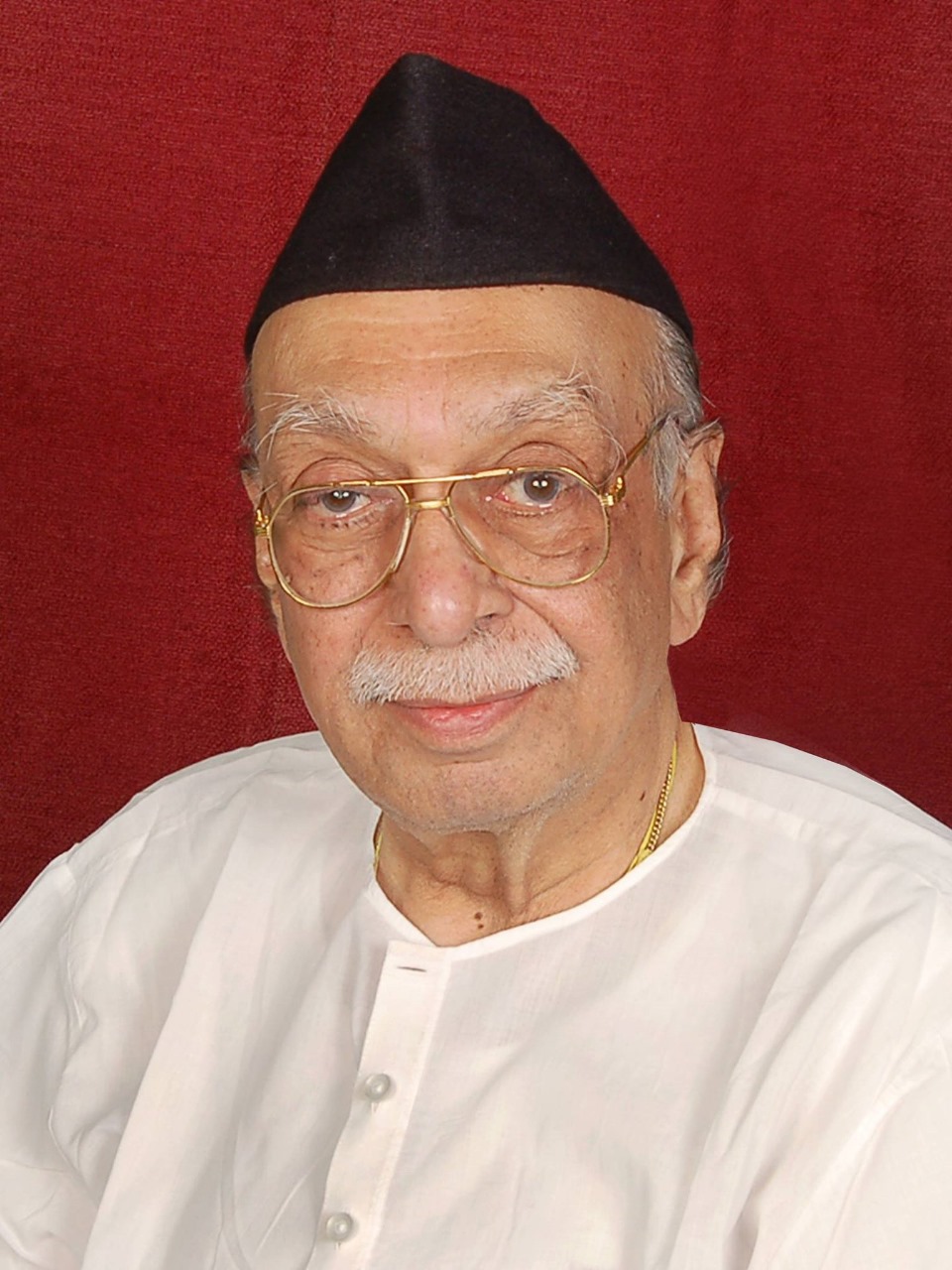
Dr. Avinash Ramchandra Aacharya
(02.11.1933 - 25.03.2014)
Dr. Avinash (Dada) Acharya:
Architect of Constructive Social Transformation
Introduction and Core Philosophy :
Dr. Avinash (Dada) Acharya stands as an icon in the socio-cultural landscape of Maharashtra, particularly Jalgaon. A visionary reformer, humanitarian, educator, and institution builder, Dr. Acharya devoted his life to nation-building through constructive social work. He firmly held that lasting societal transformation could not be achieved through fleeting agitation or top-down authority, but it requires value-based institutions, disciplined cadre-building, and an unyielding commitment to selfless public service (Seva).
Crucible of Conviction: Emergency and the Shift to Constructive Action
Deeply devoted to the Rashtriya Swayamsevak Sangh (RSS), Dr. Acharya’s life trajectory was critically defined during the Indian Emergency (1975–1977). Demonstrating immense moral courage, he actively participated in the nationwide Satyagraha to safeguard civil liberties, resulting in nearly eighteen months of imprisonment.
Rather than debilitating his resolve, this period of confinement served as an intellectual crucible. It fostered his conviction that political resistance alone was insufficient for sustainable national rejuvenation. True progress required constructive, institution-based development. After his release, Dr. Acharya shifted his focus towards creating community-centric organizations that systematically addressed the everyday needs of ordinary citizens.
Pioneering Institutions: Financial, Social, and Educational Empowerment
Recognizing that economic stability and social infrastructure are prerequisites for community upliftment, Dr. Acharya spearheaded several landmark institutional movements:
1. Jalgaon Janata Sahakari Bank:
Founded to serve the common citizens, promote cooperative economic development, and foster regional financial self-reliance.
2. Keshav Smruti Pratishthan:
Established as an umbrella organization for healthcare and social welfare, launching key initiatives including:
- Kshudha Shanti Zunka-Bhakar Centre: Offering affordable, nutritious meals to the underprivileged.
- Matoshri Old Age Home: Providing a dignified sanctuary for senior citizens.
- Madhavrao Golwalkar Blood Bank: Ensuring safe, accessible blood for medical emergencies.
- Maganlal Bafna Eye Bank: Restoring vision and driving awareness around eye donation.
Kshudha Shanti Zunka-Bhakar Centre
Offering affordable, nutritious meals to the underprivileged.
Matoshri Old Age Home
Providing a dignified sanctuary for senior citizens.
Madhavrao Golwalkar Blood Bank
Ensuring safe, accessible blood for medical emergencies.
Maganlal Bafna Eye Bank
Restoring vision and driving awareness around eye donation.
3. Vivekananda Pratishthan:
Founded on the belief that education is the ultimate instrument of character formation. Under this trust, a network of premier schools was established to combine academic excellence with holistic development, moral integrity, civic responsibility, and patriotic values (Samskar).
4. Civic Harmony and Cultural Unity:
Dr. Acharya’s vision extended directly into the civic fabric of Jalgaon. He played a decisive role in reorganizing public celebrations such as Ganesh Utsav and Rathotsav. By building collaborative bridges between local Ganesh Mandals, civic authorities, police administration, and diverse religious communities, he transformed large public festivals into peaceful, disciplined, and inclusive events, creating a lasting regional culture of mutual respect and social cohesion.
5. Leadership Style: Inclusivity, Cadre Building, & Selflessness:
Perhaps Dr. Acharya’s seminal legacy lies not only in brick-and-mortar structures, but in the cadre of selfless volunteers (Swayamsevaks) he nurtured. He believed that individual-centric organizations eventually fade, whereas value-driven human capital creates perpetual impact. His leadership was anchored to three core principles:
- Maternal Empathy: Guided by the belief “Love society as a mother loves her child.” he viewed every citizen as a part of an extended family (Vasudhaiva Kutumbakam).
- Inclusive Progress: Driven by his motto “Sab Samaj Ko Liye Saath Mein Hi Badhte Jana” (Let us move forward by taking every section of society along with us), ensuring community harmony across socio-economic strata.
- Absolute Detachment (Anasakti): In a rare display of ethical stewardship, Dr. Acharya maintained complete personal detachment from his creations. He never treated institutions as personal or family property, transferring full ownership and governance to the society.
Maternal Empathy:
Guided by the belief "Love society as a mother loves her child." he viewed every citizen as a part of an extended family (Vasudhaiva Kutumbakam).
Inclusive Progress:
Driven by his motto "Sab Samaj Ko Liye Saath Mein Hi Badhte Jana" (Let us move forward by taking every section of society along with us), ensuring community harmony across socio-economic strata.
Absolute Detachment (Anasakti):
In a rare display of ethical stewardship, Dr. Acharya maintained complete personal detachment from his creations. He never treated institutions as personal or family property, transferring full ownership and governance to the society.
Enduring Legacy: Keshav Smruti Seva Samuha (Group):
Today, Dr. Acharya’s life work thrives under the Keshav Smruti Seva Samuha, an expansive network of educational, healthcare, rural development, and environmental institutions. Guided by leaders like Shri Bharat (Dada) Amalkar, the organization preserves his founding values of participatory governance and selfless service. Dr. Avinash Acharya’s life remains an enduring testament to how moral clarity, systemic execution, and unyielding dedication can reshape the destiny of a region for generations to come.Dr. Acharya’s vision extended directly into the civic fabric of Jalgaon. He played a decisive role in reorganizing public celebrations such as Ganesh Utsav and Rathotsav. By building collaborative bridges between local Ganesh Mandals, civic authorities, police administration, and diverse religious communities, he transformed large public festivals into peaceful, disciplined, and inclusive events, creating a lasting regional culture of mutual respect and social cohesion.